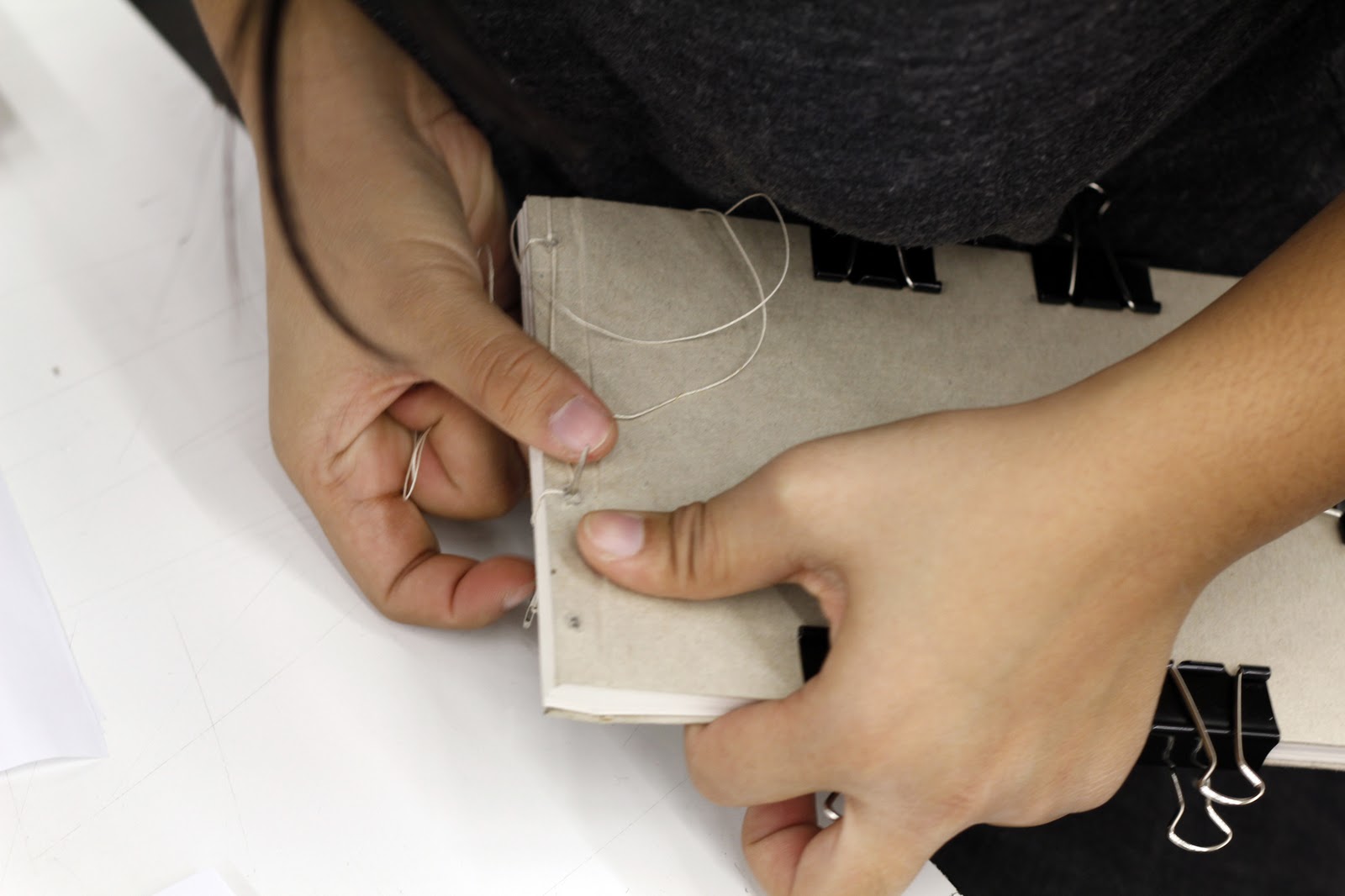
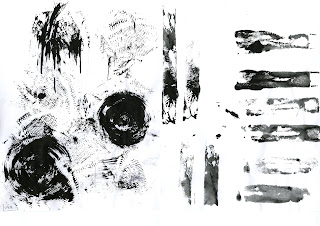
Finally, the final, final project of the semester. In executing the creation of this book Patrick and I worked efficiently and effectively together at a steady pace. For instance, while I measured and cut the covers, Patrick constructed and glued them. This project helped me see the importance of craft and preciseness when working with others, because my measurements were accurate, he was able to quickly cut and glue the covers. In the final artifact, we printed the covers with the oil from the oil filter we used to create our marks. The pages are organized by overall tonality of a group of objects, then tool and lastly mark creation method.
Also, thank you, youtube lady for teaching us how to do a 4-hole Japanese stab bind. Without you, we would have gotten lost in the mass of complicated written procedures and poorly designed illustrations.
Final Artifact:
Process:
Showing posts with label V-COMM I. Show all posts
12.10.2010
VC: Haiku - Final Storyboards
After the comments made in the critique I revised the transition from shape B to C so that the buckets of water are poured revealing the insect.
12.08.2010
VC: Haiku - Taxonomy Book Mock-Up
Classification:
Tool (alphabetical order) > Mark Method (smack, stamp, pull, drop, etc.)
Dimensions:
8 in x 5.5 in
Materials:
Binding - Stab Binding
Paper - Parchment paper/Chip board paper
Cover - Chip board
Concept:
The book is entitled "Soiled" to allude to first line of our haiku, "Dirty bath-water", but also to the soil of the earth in which the insects reside. We plan to stack our cover, chapter pages and back cover and then allow the oil filter, which was one of our objects, to stain each page gradually. As the viewer moves from page to page, the stain will decrease in size and represent movement through time.
Tool (alphabetical order) > Mark Method (smack, stamp, pull, drop, etc.)
Dimensions:
8 in x 5.5 in
Materials:
Binding - Stab Binding
Paper - Parchment paper/Chip board paper
Cover - Chip board
Concept:
The book is entitled "Soiled" to allude to first line of our haiku, "Dirty bath-water", but also to the soil of the earth in which the insects reside. We plan to stack our cover, chapter pages and back cover and then allow the oil filter, which was one of our objects, to stain each page gradually. As the viewer moves from page to page, the stain will decrease in size and represent movement through time.
| front cover |
| chapter page |
| mark page |
| back cover |
VC: Time & Motion with Lupton
I never got around to writing a post about this reading, but it was extremely helpful as an introduction into motion. Lupton essentially put into words the various principles that we've been exploring through the entirety of this semester that were the fundamental steps. For instance, in the previous dot project we really utilized the notion of implied motion by cropping a dots off the page to appear as if they were exiting or entering. For this assignment we're moving on into something a bit more literal and actually putting still images into motion on a time-line.
As Lupton states, all animation consists of change over time such as a change in position, rotation, scale, shape color, depth, transparency or a combination of any of these. In our current project we're taking our created symbols and using these methods to help reinforce the idea we are wanting to communicate. To help organize and sort out thoughts, motion graphic designers use storyboards to help us summarize and identify key moments of change overtime. Storyboards can determine the flow as well as express the personality, emotions, and gestures of the objects.
VC: Haiku - Final Statement & Artifact
There were three main objectives to this project: (1) exploiting properties of non-traditional tools; (2) understanding mark making as an aesthetic, expressive and perceptual phenomenon; and (3) exploring symbiotic relationships of concept and form. The poetic nature of this assignment allowed for a bit more open interpretation of our chosen haiku so, conceptually, I wanted to focus on the conflict between man versus nature. Man, as a destructive force that possesses the power and nature as the innocent and weak force at the mercy of man.
-Onitsura
In regards to the symbol creation and mark making objective of this assignment, my partner and I collected items that pertained to bathing, nature and analog musical instruments. I used only man-made objects to compose the first two lines of the haiku because I felt those lines spoke more directly about man. For the last line of my poem I used only organic materials, specifically grass, to create the symbol of the insect. By using specific objects to form each symbol, it helps to reinforces the distinction between man and nature.
Moving into motion, I wanted the combination of form and sound to create a reflective narrative of consequence from the perspective of man that was lighthearted with a serious tone. My choice of music alludes to both the human figure and the insect. The bright chirping sound in the clip represents the innocent insect. It exists through the entirety of animation as a reminder of its presence although insects may not always be visible. The sequence from the first symbol to second symbol alludes to how water spins as it goes down a drain. However, the rotation flashes back to a point in time where the water has not been poured yet. Then the water is poured to reveal the insect, which is happily singing in the grass. Finally, at the end of the clip the sound fades while the camera pans away from the insect into the white where the symbol of the dirty bath-water begins to fades in. This sequence is extremely critical because I wanted it to illustrate the consequence of how the pollution of man can effect nature. Overall, I'm very pleased with the overall process and outcome of this project. I feel like I've developed a greater appreciation and sensitivity for haikus and poetry in general.
To see the full animation click on the image below or click here.
Dirty Bath water
where can I pour you?…
insects singing in the grass
-Onitsura
In regards to the symbol creation and mark making objective of this assignment, my partner and I collected items that pertained to bathing, nature and analog musical instruments. I used only man-made objects to compose the first two lines of the haiku because I felt those lines spoke more directly about man. For the last line of my poem I used only organic materials, specifically grass, to create the symbol of the insect. By using specific objects to form each symbol, it helps to reinforces the distinction between man and nature.
Moving into motion, I wanted the combination of form and sound to create a reflective narrative of consequence from the perspective of man that was lighthearted with a serious tone. My choice of music alludes to both the human figure and the insect. The bright chirping sound in the clip represents the innocent insect. It exists through the entirety of animation as a reminder of its presence although insects may not always be visible. The sequence from the first symbol to second symbol alludes to how water spins as it goes down a drain. However, the rotation flashes back to a point in time where the water has not been poured yet. Then the water is poured to reveal the insect, which is happily singing in the grass. Finally, at the end of the clip the sound fades while the camera pans away from the insect into the white where the symbol of the dirty bath-water begins to fades in. This sequence is extremely critical because I wanted it to illustrate the consequence of how the pollution of man can effect nature. Overall, I'm very pleased with the overall process and outcome of this project. I feel like I've developed a greater appreciation and sensitivity for haikus and poetry in general.
To see the full animation click on the image below or click here.
VC: Semester Reflection
I want to start by acknowledging how quickly the semester went by, but I'm really pleased with the growth I've seen in my classmates and myself. The one objective spanning from project to project that I've struggled the most with is understanding how to clearly communicate an idea and how the formal decisions I make can influence that idea. Looking back to the dot project, I didn't have a clear understanding of my concept and therefore many formal decisions I made concerning imagery were mostly arbitrary. I was really disappointed with the outcome of the final artifact, but I was determined to continue to move forwards in project two. I honestly feel that I made a great deal of progress in project two in regards to this objective. I attempted to question my formal decisions more frequently throughout the process to prevent weakening my overall execution of the concept.
Another objective that I struggled with was learning how to work collaboratively. In the beginning of the semester there were other things that made this task difficult the first being that most of us had never really worked collaboratively before. Also, not knowing my partners strengths or weaknesses and just trying to get a handle of the material as an individual. It was a definite struggle in figuring out how to compromise ideas, manage time schedules and divide workloads. Going to the panel discussion and the studio tour helped me to understand the possibility of collaborative work and I feel that majority of the struggle is attitude change. Realizing that working creatively with another individual has different possibilities than working individually.
Moving forwards into next semester, there is much knowledge to be carried over:
1. Understanding when an idea isn't working or is being exhausted and deciding what steps need to be made
2. Continue iterating as much as possible in order to explore all possibilities
3. Making sure formal decisions correspond with concept
4. Taking risks
Another objective that I struggled with was learning how to work collaboratively. In the beginning of the semester there were other things that made this task difficult the first being that most of us had never really worked collaboratively before. Also, not knowing my partners strengths or weaknesses and just trying to get a handle of the material as an individual. It was a definite struggle in figuring out how to compromise ideas, manage time schedules and divide workloads. Going to the panel discussion and the studio tour helped me to understand the possibility of collaborative work and I feel that majority of the struggle is attitude change. Realizing that working creatively with another individual has different possibilities than working individually.
Moving forwards into next semester, there is much knowledge to be carried over:
1. Understanding when an idea isn't working or is being exhausted and deciding what steps need to be made
2. Continue iterating as much as possible in order to explore all possibilities
3. Making sure formal decisions correspond with concept
4. Taking risks
12.07.2010
VC: Past Project Critique
This poster is from the first round of combining line studies with photograph to create analog posters. To refresh, the image paired with the line study was a door mark created from opening and closing the door throughout the years. Conceptually I wanted to communicate the vintage quality of Union Station. When I created this poster I felt like I needed to give more context as to how the mark was created and where it was located in order to enhance the concept so I included the image of the doors.
Although I wanted to show a correlation between the doors and the line study, the relationship isn't clear. The scale between line study in comparison to the actual line mark is much greater which creates a disconnect. In addition the black bar holding the type further creates a division between the top half and lower half so the overall relationship is non existent.
Another issue that is evident is image dominance. Jamie had mentioned that if we were to add other imagery into our posters the line study must be more prominent. In my poster the photo of the doors has more of a presence while the line study becomes a secondary visual. As I mentioned earlier, the black band creates a division between the top half and lower half. It also prevents the viewer's eyes from moving to the lower half so the viewer gets stuck in the photo of the doors. Lastly, the type is extremely large, which also causes the line study to move lower in the hierarchy of the poster.
12.06.2010
VC: Haiku - Mark Making
Going back to the basics! Mark making is probably the most primitive manner of working, but at the same time it can be oh so powerful. I must admit, this was probably the most enjoyable step of this project thus far. When creating these marks, I tried to utilize ever side of the object and different ways of approaching the paper.
Shower Head


Shower Handle

Shower Drain


Rubber Stopper


Pipe


Lufa


Hair

Harmonica

Oil Filter

Rocks


Grass


Dirt
Shower Head


Shower Handle

Shower Drain


Rubber Stopper


Pipe


Lufa


Hair

Harmonica

Oil Filter

Rocks


Grass


Dirt

VC: Haiku - Analog Motifs
For this round we took our created marks and used them to make our sketched symbols. There were a couple approaches one could take to accomplish this: (1) locate the symbol in the marks already created; (2) take portions of a variety of marks to build the symbol; or (3) create the symbol in real-time by making new marks. For me, it was best to build the symbols from the marks I had already created. I was aiming for variety in my symbol creation, some that were more expressive and others that were more pictographic.
Dirty bath-water


Where can I pour you?...


Insects singing in the grass


Dirty bath-water


Where can I pour you?...


Insects singing in the grass


Subscribe to:
Posts (Atom)