3.11.2013

SX: Dieter Rams Process - 02

We've chosen to title our exhibition A Life by Design. Rams household products have significantly influenced the way we live. The name refers to the relationship between people and his body of work, but the format of the exhibition is also persona driven to demonstrate the evolution of his principles.

Program
We've dedicated the lower level to creating the home experience. The upper level will be a space to reflect and hold more of the branding of the overall exhibition.


Branding
The expression of the exhibition can be read in more than one way. It plays off of the flexibility of his products and its relationship with people.


Mobile Experience
In the mobile experience, we've chosen a horizontal format to continue the language of the flexible shelving system. This application plays a significant role in our experience. In order create a more realistic home environment we've decided to keep the details of each product within the application. Visitors will have the option to follow the life of a few personas throughout time. (maturity, love, laughter, etc.)

Beginning Exploration

3.09.2013

John C Jay


"Never let anyone define who you are by their terms."

John C Jay is a creative mastermind from humble beginnings and someone I aspire to be like. His genuine understanding of the diversity of people is really reflective in the way he speaks about design.

10 lessons for young designers:

1. Be authentic. The most powerful asset you have is your individuality, what makes you unique. It's time to stop listening to others on what you should do.

2. Work harder than anyone else and you will always benefit from the effort.

3. Get off the computer and connect with real people and culture. Life is visceral.

4. Constantly improve your craft. Make things with your hands. Innovation in thinking is not enough.

5. Travel as much as you can. It is a humbling and inspiring experience to learn just how much you don't know.

6. Being original is still king, especially in this tech-driven, group-grope world.

7. Try not to work for stupid people or you'll soon become one of them.

8. Instinct and intuition are all-powerful. Learn to trust them.

9. The Golden Rule actually works. Do good.

10. If all else fails, No. 2 is the greatest competitive advantage of any career.


3.08.2013

SX: Self Assessment

Oh, how quickly time flies.

Every project has its high, low, and even medium moments. After internalizing these past couple of weeks I've learned a great deal. It's always nice to see how someone else works and thinks during partner projects. I worked with Jumper once for the line studies project so it's nice to be able to come full circle.

Anyways, I've learned from previous projects that with spatial work it's extremely important to get yourself within context as soon and as often as possible. This is one aspect of our process that I'm most proud of. While we're all familiar with the area after, it amazes me how much you don't notice when you're not actively trying to audit the space. Rather than searching google for how wide a street is, we ran outside with a measuring tape and discovered those elements on our own.

In developing our concept we didn't think to research and take into account the architecture of the buildings around campus. We were more focused on the student body that inhabited the environment and what they were passionate about.

In our form making we spent a lot of our time making sure everything was accurate and clear in regards to dimension and how we were representing our idea. Laying out our elements in a way that seemed legitimate in a sense was probably the other element I know we both enjoyed. However, maybe we were too focused on trying to make everything accurate and consistent that we may have missed an opportunity to build more of a narrative.

Moving into project two, I want to make sure I focus on telling a narrative and that I'm well researched before getting too ahead.

3.06.2013

DP: Week 6

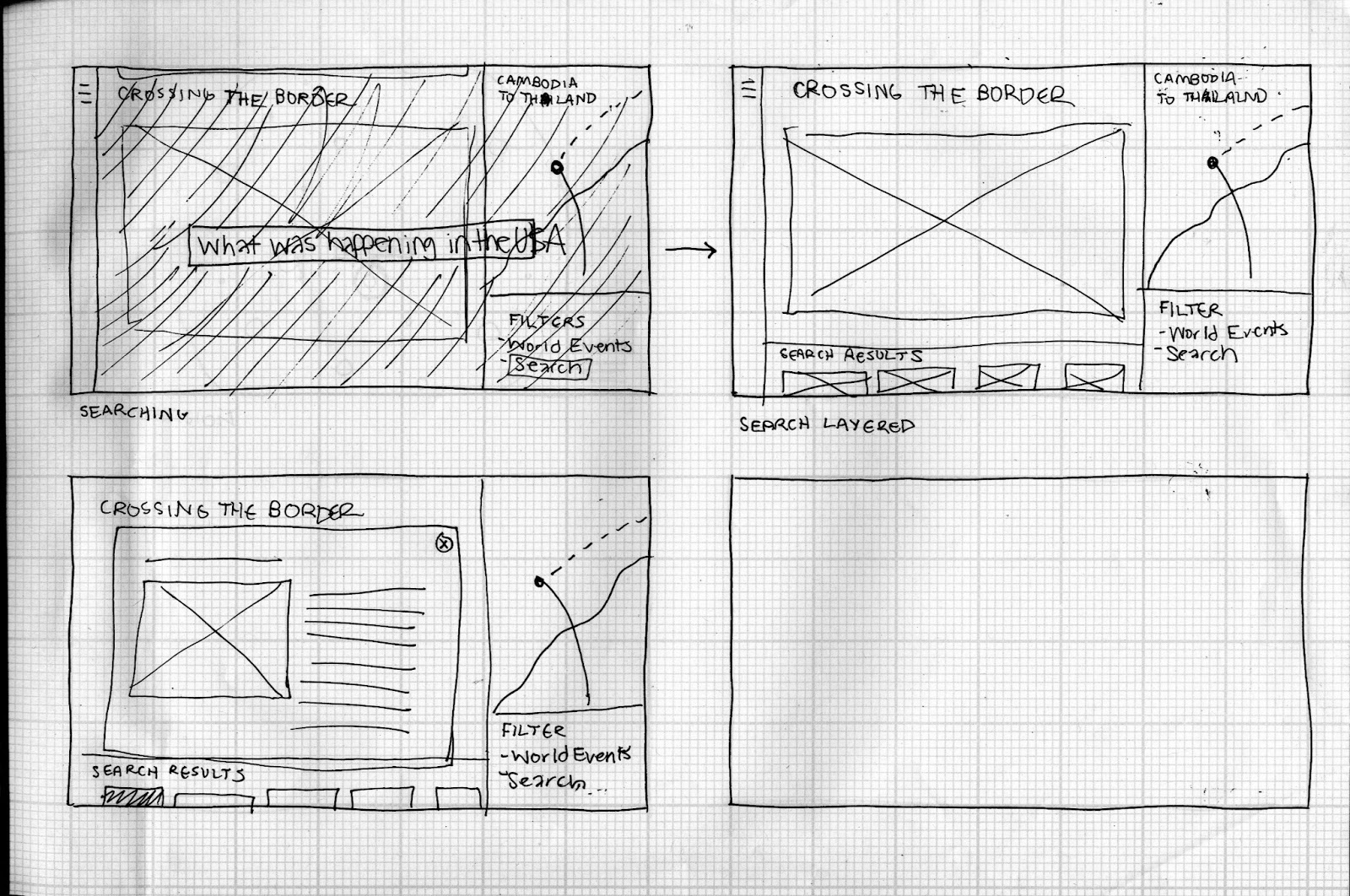
This week I've been focusing on flushing out my wireframes and doing some motion tests/research.

--------------------------------------------------------------------------------------------------------------------------------
Wireframes
Scenario One

Scenario Two


 Scenario Three

Scenario Four


--------------------------------------------------------------------------------------------------------------------------------

Formal Experiment
One visual directions of the main Petree space I've been wanting to explore are objects pushing into the z-axis. I needed to figure out the best way to go about representing this space and if I'd be able to pull it off before I go any further. The first thing that came to mind was to build it in Cinema 4D, but After Effects also has the ability to extrude and light shapes. Below are some shots of this exploration.

Cinema 4D

While I love the way these guys look, I have to be real. I know i've been wanting to find a reason to use c4d, but it may not be appropriate right now. I need to also consider my workflow. I don't know my machine will be able to handle the rendering especially if and when we hit crunch time. I think I'll be able to do what I need to do in after effects. It was nice to play around while it lasted.

--------------------------------------------------------------------------------------------------------------------------------
After Effects

While searching the inter–webs I found some examples on videohive that gets across the type of motion I want to accomplish. Below I've attached some of the ones I'm interested in. Videohive is a nice way to learn how professionals do motion and the price for the source file isn't too bad. It's usually around the $5–$12 range.


Shapes
Motionpack Shapes 1
Motionpack Shapes 2
Shaping
Floating Cubes


3.03.2013

SX: Dieter Rams Process - 01

At its essence, Dieter Rams' ten principles are about the interaction between man and machine. In order to understand this relationship, our exhibition looks to place Rams' products in their intended time and context. The space will have the look and feel of an actual home. Touches of personality within the space such as ash trays, toy throws haphazardly on the floor, magazines, lp collections, and whiskers will add deeper intimacy with the environment and collection. Beyond the living environment this will also provide insight into the times and lifestyles of the personas.

keywords:
» Personal
» Immersive
» Interactive


products we're planning on highlighting:


please enjoy this video:


resources:
http://dieterrams.tumblr.com/
https://www.vitsoe.com/gb/about/dieter-rams
http://www.braun.com/us/home.html

2.27.2013

DP: Week 5

I think I'm going to extend my wireframing period a bit longer. I need more time to explore the structure of this system and to make sure it's solid.

Site Map
This site map has really helped me organize my ideas and the experience I want someone to have, but I'm stalled. I just want everything to make sense conceptually and logically. After talking to Marty, I should keep it simple as it should be then use the wireframes to accompany the explanation of the features.


--------------------------------------------------------------------------------------------------------------------------------

Wireframes
These are still very rough. I've been going back and forth between working out my site map and exploring how to visualize this system. They look a bit worm-ish right now, but that will most likely change.

Scenario 1:

Scenario 2:

2.24.2013

SX: Project One - Final


Our system focuses on the idea of layers. As a institution we're layered in the sense that we're comprised of students, departments, and the different schools to make up the Kansas City Art Institute. More importantly its about the layering of thoughts and ideas, of people and collaboration that truly embodies the essence of the artist and our school.

The bright colors of our system represents the spirit and energy of the school. These colors are juxtaposed against a dark brushed metal to not only allow them to stand out within the surrounding environment, but to also make them the focal point.

2.20.2013

DP: Week 4

In order to give my scenarios a bit more focus, I've decided to hone in on developing three concepts: the past, the present, and the future. These three elements are intertwined and vital components in creating a holistic story.

As a side note, since so many of us are visual people, I've pull examples to help explain and visualize concepts. These inspirations are tools and by no means the solution to my project.

--------------------------------------------------------------------------------------------------------------------------------

Scenarios
The Past:
 My first scenario focuses on showing the timeline of a family member's journey. In the example below, as you scroll through the photographer's adventure on the left, the point on the map to the left moves as the storyline progresses. For my family tree, there's opportunity to create more of a storybook like timeline. Adding the national news layer will help fill in missing gaps, but also provide global insight of the experience.

SRF Seidenstrasse
360 Degree Image

The Here & Now:
As of now, this scenario will be more of an exploration as to how family members can contribute and request content more directly. I know this sounds pretty vague right now mostly because I'd like to push the idea of how we're uploading media, but still in question as to how right now. I know it's difficult for my mom to want to talk about some aspects of the war. It can be extremely painful, so much that my sister has sworn to never ask her about the subject again. Maybe there's a different way to approach these moments

Back to the Future:
Lastly, the future will be focused on an individual exploring the system, using the advance search feature to pull up specific family data pertaining to their interest that will be visualized in some fashion, then drawing a conclusions based off of that information.

--------------------------------------------------------------------------------------------------------------------------------

Note to Self
My next step is to go ahead and start gathering real and specific data to work with and begin developing low content wireframes. In writing this post I've sort of realized how large this could get so I just need to remind myself to narrow. It may be a situation where I just keep the idea within my site map and focus on very short, but vital moments.

--------------------------------------------------------------------------------------------------------------------------------

Interface Research
I believe motion is extremely important in developing an interface. It's a large part of this project that I'm wanting to explore. After doing an audit and thinking back to the MX project this idea just because more apparent to me. I need to be thinking in motion so on top of developing the wireframes I should be doing motion experiments.

Below are some examples of interfaces I've gathered in my research that somehow aligned with the ideas in my head.

Main Space:
In my head I've been envisioning how to visualize my family tree and here's an example I found that's pretty close to what I've been tossing around.


UNIVERSERIES


2.19.2013

The ADDYs

A visualization of how much we've learned

These past couple of weeks Jessie and I were given the challenge of developing the presentation for the ADDYs. I'm not ever sure where to start, but I can say with definite certainty that we learned a whole lot from the experience. For this challenge to be only our second project, I still can't believe how much they involved us in the process. It really only dawned on me when we were backstage waiting for our cue to hit the next slide, fingers hovering nervously above the arrow button on the keyboard.

Maybe it's just the novelty of it all, but I think it's still one of those monumental moments you never forget so I just wanted to take some time to write about it.

Overall, there were a lot of firsts. This is the first time I've ever been a part of a production with a lot of different types of people that required continuous interactions. Our main responsibility was to organize and typeset the contents of this massive spreadsheet into a digestible keynote. We also took part in multiple rehearsals with vocal talents, and various members of the AAF-KC board to make sure everything aligned with the script. It was very much a team effort to make sure every detail of the presentation was correct.

It was such an honor to have, Jeremy Johnson, the director of the AAF-KC Art & Copy Club acknowledge our efforts in the production that evening on stage. For that I'll always be grateful.

2.17.2013

Student Portfolio Workshop


The opportunity to talk about your work is like falling in love all over again.

This past week I've been having so much trouble figuring out how to lay out my portfolio. I guess it's not surprising, but after going through this process I realized something. Maybe somewhere along the way I lost sight of what's really important.

The act of talking about your body of work requires you to look within and pull out those memories. Often times the things you choose to articulate in these situations are the distilled sum of those projects. In other words, what matters most. Having fresh eyes and ears summarize and reinterpret those experiences, well, what's left is who you are as a designer and what you want to become.

It's so easy to get stuck in your own head. What was reiterated to me this Saturday was that my design is about people, interaction, and ideas. Since I've been having so much trouble laying out my work I've been going to the inter-webs for inspiration. A lot of the portfolios I found were from a particular school that often focuses on aesthetics. These portfolios were really nice and maybe because they seemed aesthetically beautiful, whatever that means, I almost took it as the truth or the way a portfolio should be.

I ended up in this circle of maybe if I put this folio here or move this over 5 pixels it'll make everything better, but of course it didn't. One of my reviewers mentioned that the way I talk about my work is very different from how I show it. His exact word were "it seems clinical," I believe. Anyways the moral of this story is that your portfolio is a reflection of your work and a projection of who you want to become so don't make it anything it's not.

I guess I just needed to be reminded of that.

SX - Project One - 03

This week our focus has been on refining our system elements, laying out the book, and presentation. Since we're working with an A to B scenario, we've decided to lay out our proposal book in a similar fashion. As you're going through the book we've placed our map on specific pages to help readers visualize and understand the experience. Below are some images of the remainder of the system we needed to build. Also, because we're working with real space, here's an image of our math for accuracy.


Elements


The Book